A Well-Designed Table Makes Lingering Possible
Learning from Austin Toombs and the concept of 'implicit care'

Dusk is falling on the Plaza de Sevilla and a group of friends linger to play just a few more songs. The camera pans around—half empty beer glasses, guys playing guitar, others singing, one or two adding the soft flamenco claps of palmas sordas to add a counter-rhythm.
It’s the kind of scene you might stumble across walking the streets of Granada or Córdoba on a summer night and lead you to exclaim—this is what living is for!
Magical moments of togetherness like this are precisely what a new cohort of scholars are trying to understand—and strengthen. Although there are beautiful examples of digital spaces that cultivate connection, by and large, it is nearly impossible to recreate this intimacy and beauty online. The tools most of us use are designed for productivity, efficiency, or, said better, revenue generation—rather than an evening of making flamenco music together.
Some of the scholarly inquiry includes MIT’s New Social Forms project, where researchers collaborate with designers, technologists and practitioners to “scale the social architecture that strengthens connection.” And at Indiana University, Austin Toombs leads the Community Computer Interaction Lab—where he and his team study how technology shapes the ways people connect, support each other, and build community.
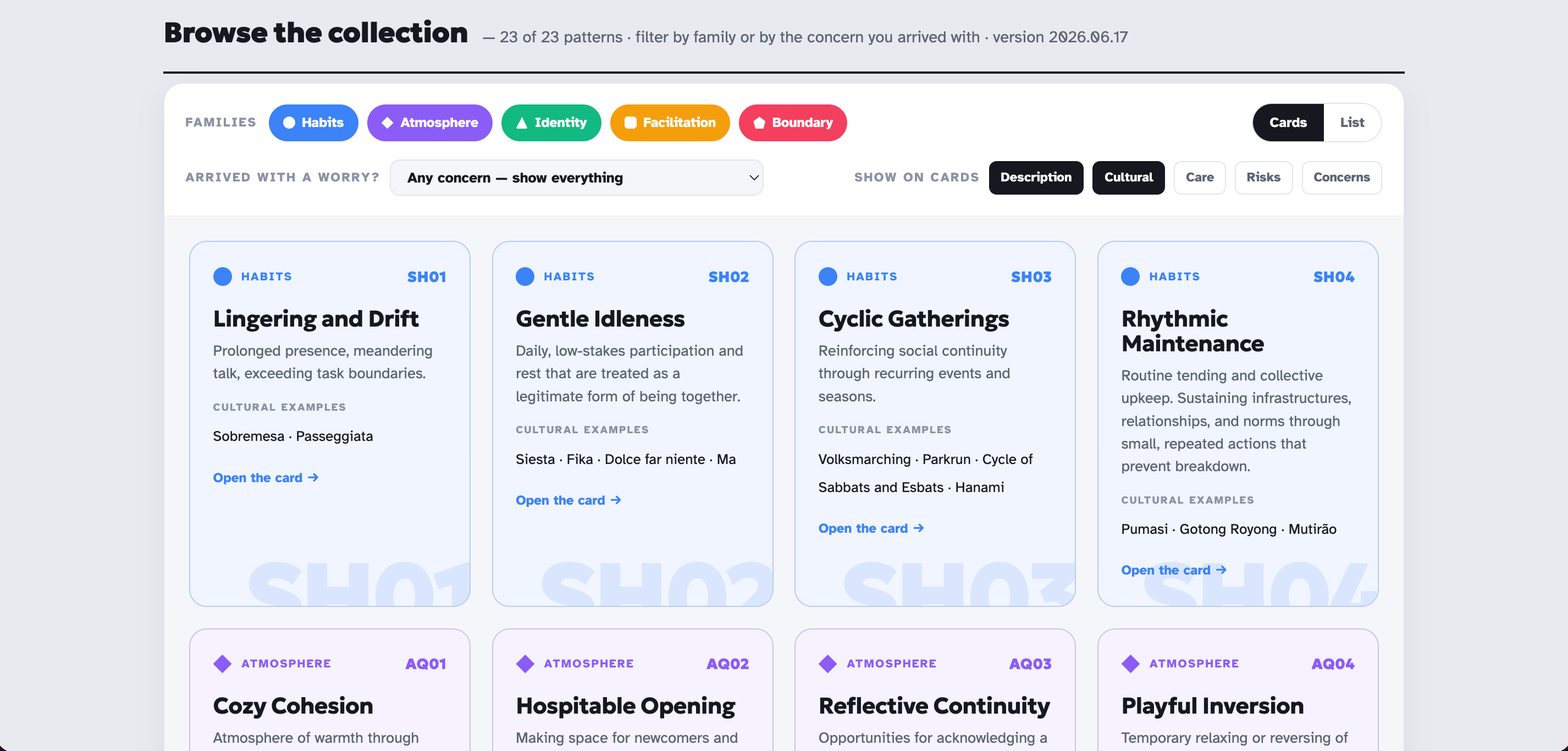
Austin and I spoke recently after he launched a fantastic new project called Patterns of Everyday Care. It’s an enormously useful collection of 23 design patterns to help you cultivate the subtle, everyday ways people care for one another in online communities and it helped me realize what might be possible in digital spaces if we paid attention to the kinds of things Austin studies.
Each pattern names a cultural context you might encounter it in, illustrates how it shows up online, identifies risks, and suggests the right use case in a digital space. I wanted to learn more, so connected with Austin to ask him about the concept of implicit care, whether these digital spaces can ever offer true community, and the potential for small groups.
CASPER TER KUILE: Austin, thanks so much for the work you’re doing—and congratulations on the site! It’s such a useful tool. I want to ask you about one of the core concepts in your work: ‘implicit care.’ What exactly does that mean? And how you started thinking about it?
AUSTIN TOOMBS: Thanks Casper—great to talk with you!
Well, implicit care describes the forms of care and social support that work best when they’re backgrounded, indirect, or even invisible. You might think of a neighbor who says, “we have too much zucchini, could you help us by taking some?” That could be tangible support that has been deliberately downplayed, so it doesn’t feel like charity (though, of course, it could also just be that they have too much zucchini!) Another example is including a new group member (new colleague, new friend, new club member, etc) in a group decision so they feel like they belong, without announcing that’s what you’re doing.
CTK: Gotcha—you’re signaling to this person that they’re important to you, as much as you’re interested in their contribution.
AT: Right. Or, a third, which we’ve probably all done, is to send a friend a meme as a way of saying, “I’m thinking about you” without saying it.
The thing that makes this kind of care interesting and tricky is that it often works precisely because it stays subtle. Naming it out loud can break it. If I tell you I invited you so you wouldn’t feel lonely, I’ve just called attention to your loneliness.
I first became interested in the topic while taking a Critical Qualitative Inquiry course with Barbara Dennis at Indiana University. Since that class, I’ve been incorporating it into many of my own research projects, from studying hackerspaces for my PhD dissertation over 10 years ago to my current National Science Foundation-funded project analyzing interpersonal interactions on Reddit, Discord, and Facebook. Some of the most important kinds of community-sustaining work are less about specific platform features (posts, replies, reactions) and more about things like people lingering in a voice channel after the game they were watching has ended, someone gently redirecting a conversation before it turns sour, and long-running inside jokes that people can feel part of. This kind of “invisible” support could be better supported by platform design.
CTK: I love that—and I’ve never really imagined how digital tools could better support that kind of invisible care. I think of New_Public’s work on reimagining social media as a good example of working on this, too. (Check out their latest report if you haven’t seen it yet!)
But I guess I have a bigger question here. Your scholarship is all about the way that humans interact with technology. But in this moment with AI and our growing understanding of the dangers of social media, the word ‘care’ feels very far from people’s minds when we think about technology. How does your project sit within that tension?
AT: That distance is part of the problem I’m working on. Platforms, for both technical and profit-driven reasons, tend to flatten the enormous range of human social interaction down to a handful of attention-grabbing mechanisms: post, share, react.
In-person, you can notice who needs a check-in, who’s hovering at the edge of a conversation, and who needs to be gently reassured they belong. Being in-person doesn’t make it easy! Those are still skills.
CTK: Yeah, one hundred percent. (This is the kind of emotional labor that often goes unrecognized and unpaid!)
AT: But online, the cues that make that kind of noticing possible don’t really exist. Some argue that we should just log off. That’s the easy answer, but I don’t think it’s realistic for all apps (except maybe the ones specifically designed to be addictive).
Especially amid rising loneliness and isolation, there is social value in these platforms if they can be designed in ways that don’t flatten implicit forms of care. My lab, the Community-Computer Interaction Lab, focuses on that “if.” We study how communities actually maintain themselves, including the interpersonal labor that’s necessary for a community to survive but that designers rarely see or account for, and then ask what design would look like if it took that labor seriously.
In connection with your work, Casper, I’ve learned a lot from How We Gather and The Power of Ritual, which describe what caring communities are at the level of gathering and meaning-making. The everyday care patterns we recently published focus on the interaction level, such as how and where care actually takes place between people. To me, it feels like different zoom levels of the same kind of question.

CTK: Yeah, the breakdown of specific practices and their cultural ancestors really resonated with me.
Just like the musicians in the clip above, I know you’re also thinking about designing for small group interaction, specifically. I’ve been obsessed with small groups for a long time because they’ve changed my life so significantly (first being in an activist small group, then in Divinity School, and most recently with Nearness.)
Based on that experience, I know that most tech is built for one-on-one interaction (like text messages) or huge groups, but we lack the technological infrastructure for a better chat experience with 6-12, for example. What might that look like?
AT: Exactly, most social technology is built for two scales: one-on-one messaging or large broadcast messaging. The 6-12 person group, which is arguably the scale where this kind of implicit care works best, gets a group chat, which is really just a one-on-one tool with more people in it.
Part of why the pattern collection we’ve been working on is based on cultural practices is because so many of them are small-group practices. Sobremesa, for example, is a Spanish and Latin American practice (or “tradition” or “ritual” depending on the framing) of lingering at the table after a meal.
If we think of that as a design prompt, it becomes easier to imagine how to design for the time after an official activity finishes, rather than letting a call or a conversation end abruptly.
CTK: Oh heavens, yes! Coming out of a breakout group on Zoom back into a larger group is still one of the most awkward digital transitions!
AT: That’s a perfect example—right!
Similarly, the Italian passeggiata, which is the low-stakes evening stroll, suggests ambient, low-pressure ways to be “around” others in your community without an agenda or an obligation to perform. Swedish fika suggests protected, recurring pauses.
CTK: In Dutch, we have the word gezellig which is probably the opposite of whatever Microsoft Teams is :)
AT: Hahaha, right!
So, for the small groups, I’d want tools that support:
rhythm (recurring, low-stakes touch-points rather than one-off events),
atmosphere (a sense of shared mood, not just a message log),
and plausible deniability or ambiguity, which leaves space for someone to check on a friend without it becoming A Conversation About How You’re Doing.
In my lab, we’re prototyping lightweight Discord bots and browser extensions for these kinds of things. Not bots that do the care work for people, but bots that create conditions where people can more easily care for each other.
CTK: That’s really exciting. Would love to see those when they are ready!
AT: Relating this back to the question about the tension between “technology” and “care,” you could imagine a (bad, in my opinion) outcome where we just create bots that send automated “thinking of you!” messages. That’s not care, and people know the difference.
CTK: Right—it is helpful to have a calendar reminder that my friend’s birthday is coming up, but I don’t want the calendar to auto-send a text. That undermines the whole experience of connection!
AT: Right. The distinction I use is between performing care and hosting it. A well-designed table doesn’t love the people around it, but it makes lingering possible. That’s the kind of thing I want from technology: infrastructure that notices what humans need in order to care for each other (time, rhythm, low-stakes ways to show up) and provides space for those things while getting out of the way. The care itself stays human. The design question is whether our platforms make that human work easier or harder, and right now they mostly make it harder.
CTK: So great. Thank you Austin—I appreciate you and the work you’re doing!
AT: Thanks for having me, Casper.
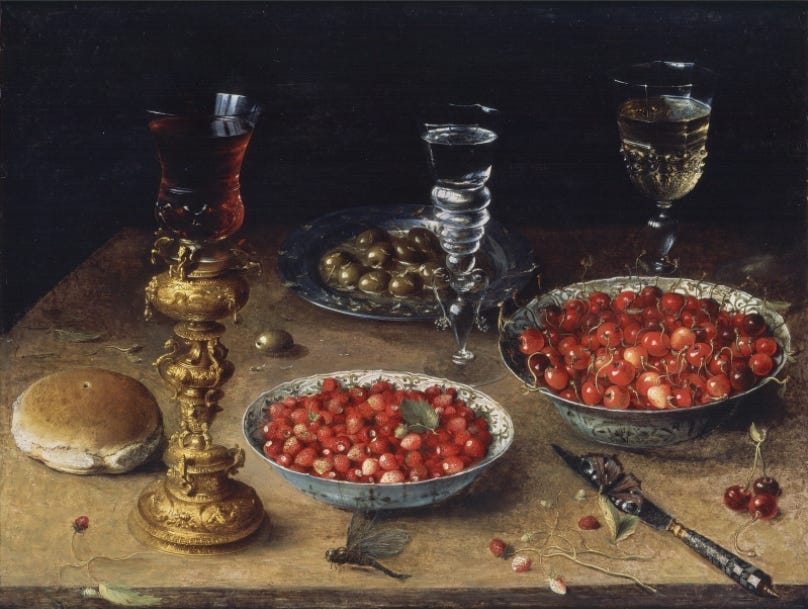
I keep thinking about Austin’s example of a well-designed table. When I put flowers in a vase, or light a candle, or arrange the bowl of cherries just-so—it’s not that these objects love the people I'm going to gather around it. But it makes it possible for them to linger and for us to love one another well. As hosts and gatherers and cultivators of community, this is central to our work. And we should have the tech tools to do it digitally, too.